Quality & certification
"Certified seed" is a legal status, not a marketing phrase. Here is exactly what it means, and how to check it for yourself before you buy.
The basics
What certification actually certifies
Certified seed is produced under the supervision of a state seed certification agency. The agency inspects the standing crop in the field to confirm the variety and isolation distances, then tests the harvested seed in a laboratory for germination percentage, physical purity and moisture content. Only if the lot passes both stages does the agency issue a numbered certification tag.
The certification belongs to the lot, not to the brand. A company cannot be "certified" in general — each individual lot is certified, or it is not.
Seed classes
Four classes, in order of generation
Seed multiplies down a chain from the breeder. Each step is one generation further from the original, and each has its own certification standard.
- 01
Breeder seed
Produced directly by the plant breeder or research institute from nucleus seed. The origin of the chain, and the most genetically pure.
- 02
Foundation seed
The progeny of breeder seed, multiplied under strict supervision. Used to produce certified seed.
- 03Certified Seed
Certified seed
The progeny of foundation seed, and the class ordinarily sold to farmers. Carries a certification tag from the agency.
- 04
Truthfully labelled
Not certified by an agency. The producer declares the quality on the label and is legally answerable for that declaration. Legal to sell, but it is a self-declaration, not third-party verification.
Tag & seal
How to check a pack before you buy
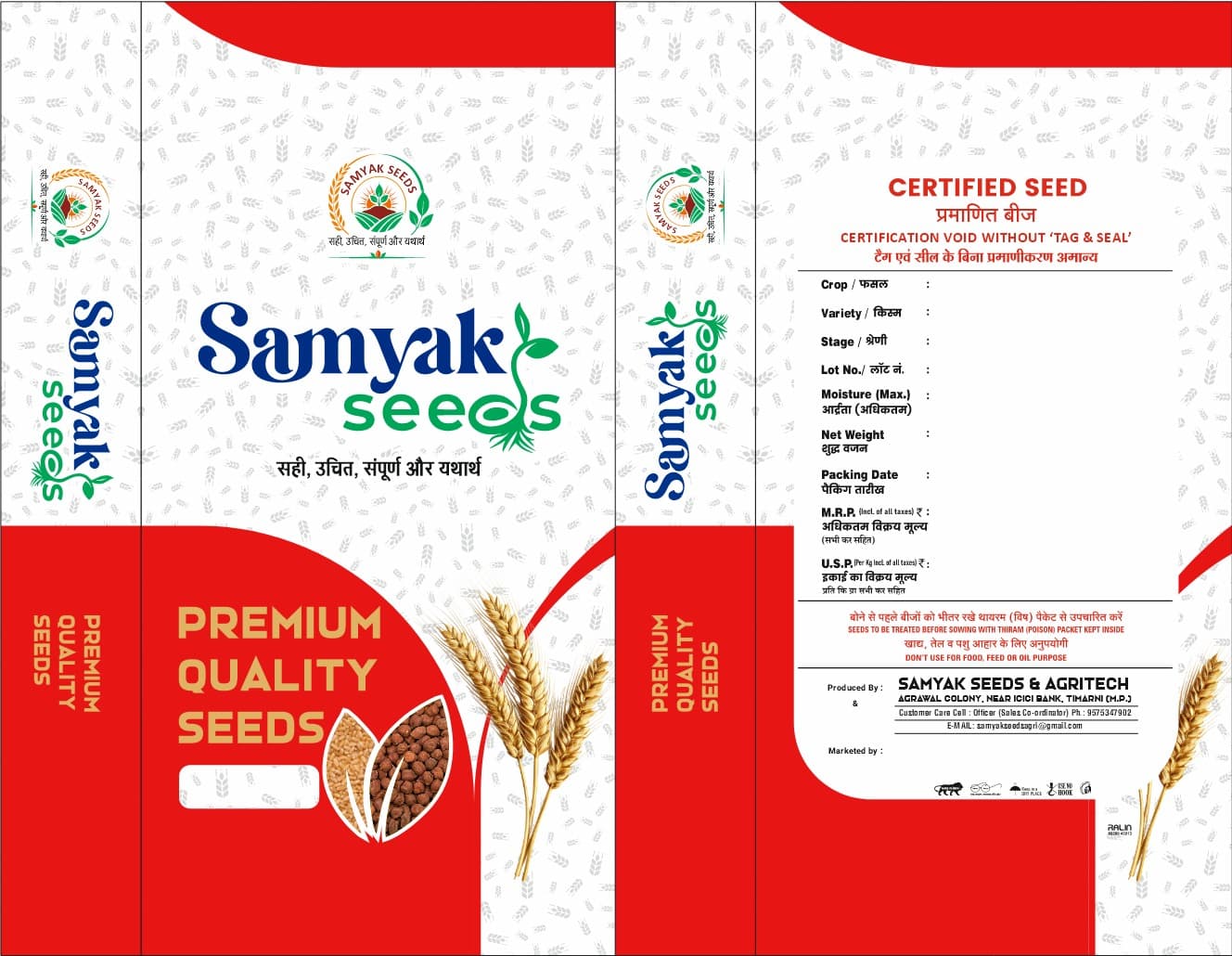
Every Samyak pack states: certification void without 'Tag & Seal'. That is not fine print — it is the whole basis of the guarantee.
Certification void without 'Tag & Seal'
टैग एवं सील के बिना प्रमाणीकरण अमान्य
As printed on every Samyak Seeds pack
Is the tag there at all?
A certification tag should be stitched or fixed to the bag. No tag means no certification, whatever the printing on the bag says.
Is the seal unbroken?
A broken or re-stitched seal means the bag may have been opened. Do not accept it.
Does the lot number match?
The lot number on the tag should match the lot printed on the pack. A mismatch means the tag does not belong to that bag.
Is it within date?
Check the packing date and the validity period. Germination falls with age, especially if the seed has been stored badly.
Standards
What is tested, and why it matters
- Germination
- The percentage of seeds that produce a normal seedling. This determines how much seed you actually need to achieve your target plant population.
- Physical purity
- The proportion of pure seed against other crop seed, weed seed and inert matter. Impurity means you are paying for, and sowing, something other than your crop.
- Moisture
- Seed above the permitted moisture level loses germination in storage and can develop mould. This is why the maximum moisture is declared on the label.
Traceability
Why the lot number matters
The lot number ties your specific bag back to a specific field, a specific harvest and a specific set of laboratory results. If anything is ever wrong, the lot number is what makes it possible to investigate rather than argue. Keep the tag until your crop has established.
Keep the tag and your purchase receipt until the crop has germinated and established.
Our certification details
Our seed licence number and certifying agency will be published here once confirmed for the current season. Please call us in the meantime and we will provide them directly.
Data pending
This figure has not been published yet. Please call us for accurate guidance before sowing.